
A Tribute to Ed Fowler — A Mentor, A Friend, A Legend
There are some people who come into your life and leave a mark. And then there are the rare few who help shape who you become—not just in what you do, but in how you think, how you carry yourself, and how you treat others.
Ed Fowler was one of those rare few.
In January, we lost Ed. And while words will always fall short of capturing a man like him, I feel compelled to share what he meant to me—and to so many others.
More Than a Mentor
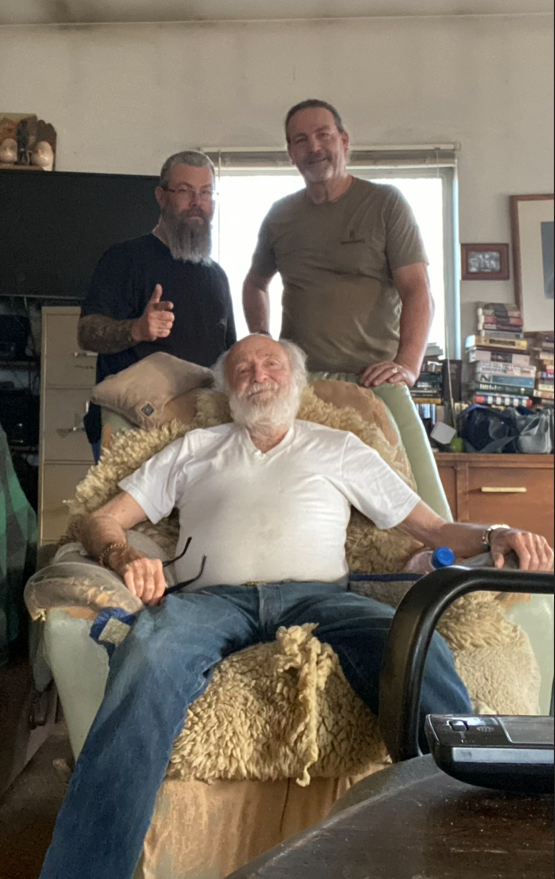
I developed a deep interest in knifemaking from a simple 7th-grade project. In 1967, shop classes had not yet been deemed non-essential. (The ignorance and arrogance of higher education’s belief that the craft arts could be sacrificed is a whole different conversation for another time.) One of my projects was making a “cold” chisel. The coolest part was that we got to use a single-burner gas forge to heat our “hex” stock to a temperature where it could be formed into a flat cutting edge. The low roar of the gas igniting in that small forge was intoxicating to a 13-year-old boy.
That experience would be relegated to slow burn over the next 37 years while a career and family took center stage. Once the internet became available, my first search was “blacksmithing.” Since that search, I've been dabbling with fire and steel. Trying things on my own, failing, and asking others for help. That process continued for the next ten years, when I had had enough failure. I needed someone who knew “the way.”
As luck would have it, the 2010 Atlanta Blade Show was scheduled for June, one month out. Surely there would be answers to my questions there, or at least new leads toward making quality knives with intention. The Atlanta Blade Show is the largest collection of custom and production knife makers in the world. Anything related to knives is there. It was both overwhelming and exciting.
Having worked at trade shows, I knew the show program was the best place to start. While looking through the breakout sessions, “The Good, the Bad, and the Ugly - Forty Years of Knifemaking,” presented by Ed Fowler, spoke to me. I can’t tell you why that one jumped out at me, but it did. I noted the time and set out to find the room so I wouldn’t be late.
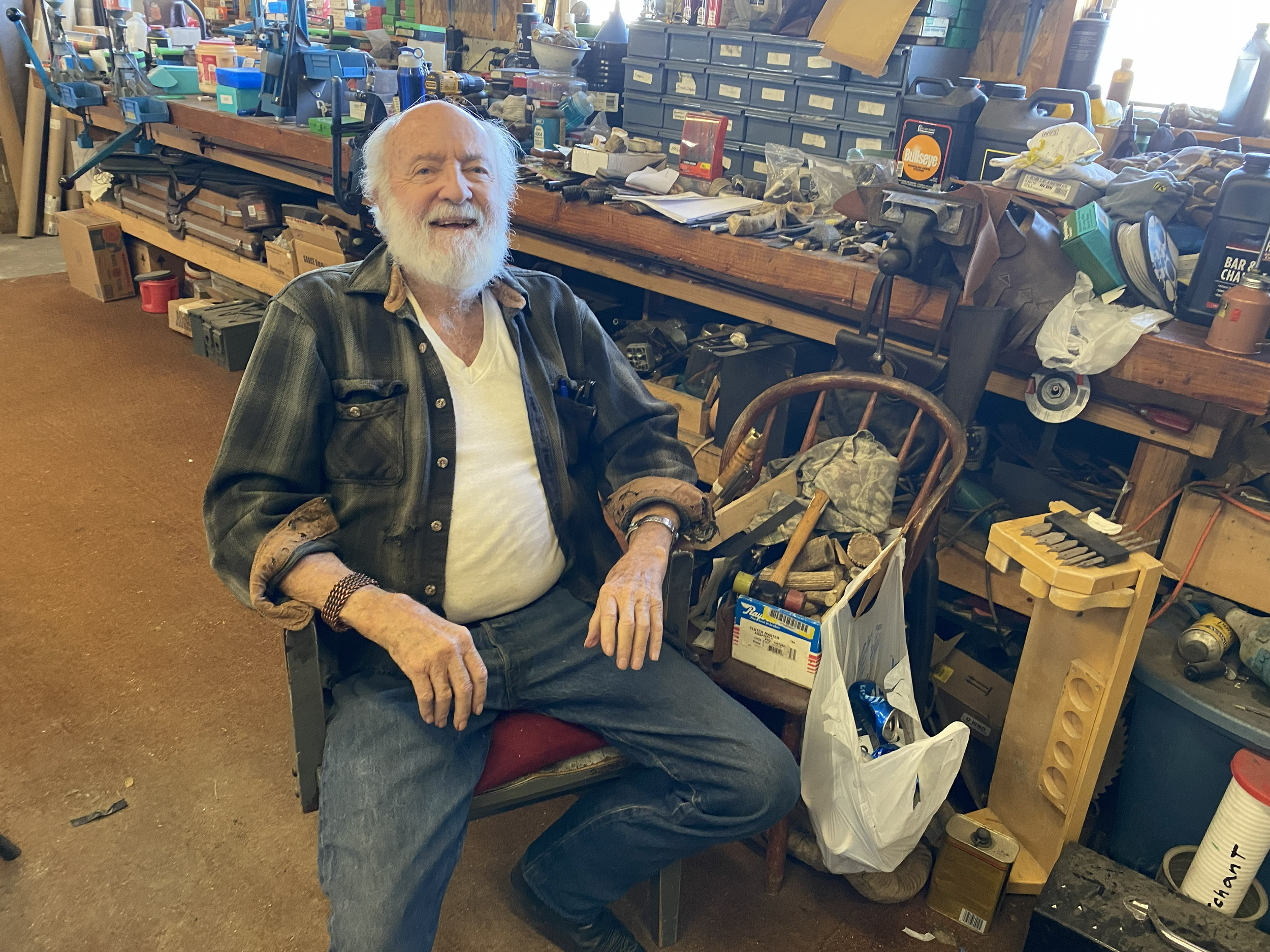
My first glimpse of Ed is indelible. He was a tall, thin, old man back then. His clothes were straight out of an old Western. His hat was of the Montana style, salt-stained around the headband and anything but new. A worn denim shirt and jeans. A cowboy belt with a large rodeo buckle. And his boots looked like he had walked miles along his “ditches” because he had.
I would come to learn that Ed disliked the “Ditch Rider” with all his being. Ditch riders show up in trucks these days, but not long ago, they rode horses; hence, the term 'ditch rider'. The ditch referred to irrigation ditches. Ditch riders controlled the water flow, or lack thereof, for his sheep. The West’s version of a bureaucrat. And that is the heart of Ed’s visceral disdain- he had no use for unaccountable government types wielding control over his life.
One more thing about his boots. They were worn out before he took ownership. He acquired them at the thrift store in Riverton, Wyoming. Frugality was another one of Ed’s values. There was not a pretentious bone in his body.
Ed also wore a heavy silver cuff adorned with turquoise stones and a copper cuff he had made by braiding copper wire and soldering the ends. All told, in those first few minutes of studying Ed, authenticity and truth were my gut feeling. Ed was the real deal!
After he finished, I approached him, hoping he would teach me his methods. I was glad to know that he did, but only one-on-one, which sounded expensive. $300+ per day got his students 24-hour access to his shop and his guidance when he wasn’t sleeping. I signed up on the spot in June of 2011. I reported to the Willow Bow the following month to begin my journey into building world-class blades the Ed Fowler way.
I drove my Cadillac CTS-V from Granger, Indiana, to Riverton, Wyoming, not expecting that a Four Wheel Drive truck would be entirely more appropriate. It was when his gravel lane and his shop became separated by a deeply rutted wash that the low-profile Cadillac was woefully out of place and inadequate. After significant consternation, I arrived at his shop. It was apparent that Ed lived as modestly as he dressed. He showed me around his shop before we had supper in a large room adjacent to the shop. It was his office, bedroom, and kitchen. Even though there was a small home close to the shop, he chose to live in the shop.
That first evening, we drank whiskey and talked. When I spotted his copy of Ayn Rand’s Atlas Shrugged on his bookshelf, I knew that what had started as an affinity for Ed would deepen as we shared a conservative worldview. We had a lot to talk about. At the end of the evening, he pointed me toward the small, well-used trailer I would be staying in for the week. The following day, after breakfast, the journey started.
Ed fired up the tunes once he got me started on a project. For seven days, I listened to 1940s country nonstop. I like my country music, but not the 70-year-old variety! But it didn’t matter. I wasn’t in his shop for the entertainment, and it was HIS shop.
It wasn’t long before I ground off the end of a finger using the belt grinder. That’s when Ed introduced me to the primary first aid remedy of the Fowler knife shop: paper towels and Super Glue. The pain vanished, and the hardened shell served as protection against further damage.
While I forged, Ed sat in his lawn chair, coaching me. In his experience, he knew that a defining trait would emerge. Mine was “productivity.” I came by it honestly, having grown up in a production machining environment, but I was more focused on soaking up as much knowledge and skill as I could in that short week. I wanted him to see my mistakes so that he could correct them. The more I produced, the greater the likelihood of seeing the variety of mistakes, and the more time I had to build muscle memory before I left the presence of greatness.
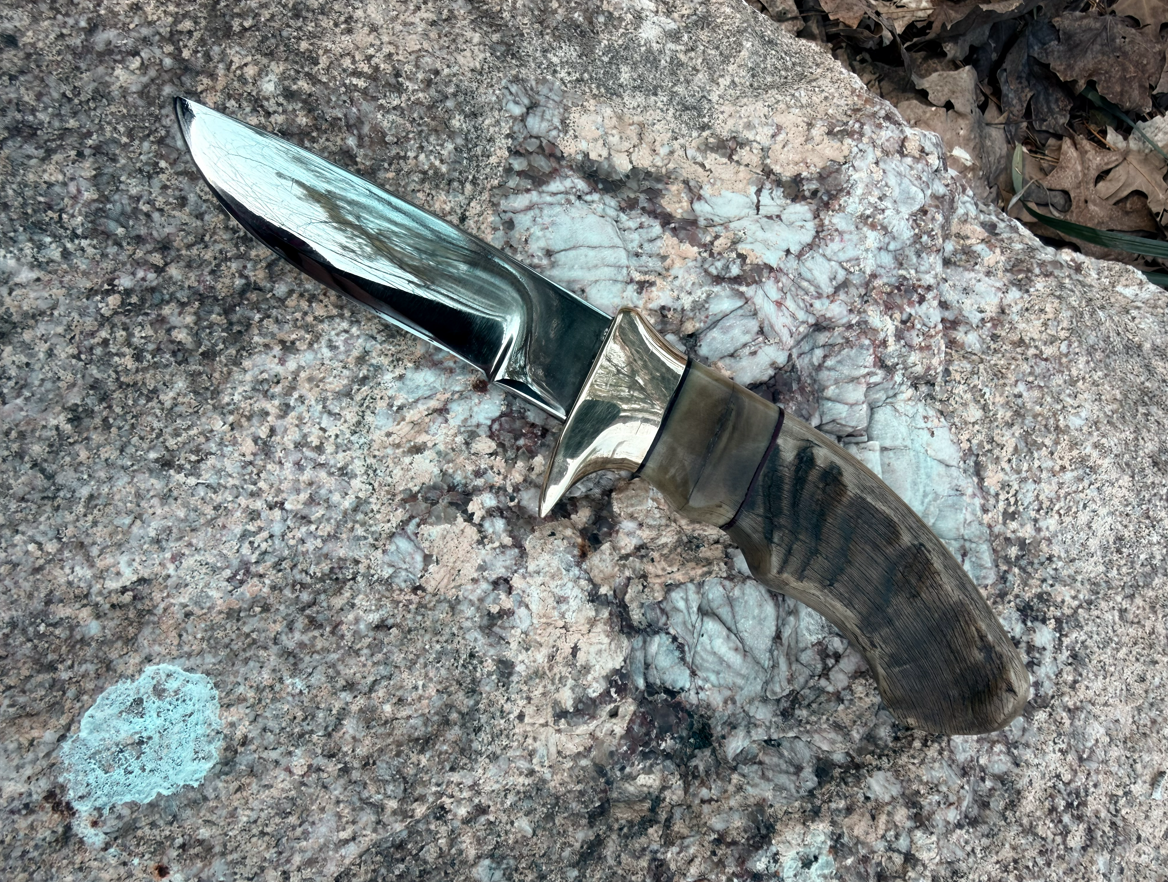
Ed wasn’t interested in shortcuts or trends. He believed in fundamentals. In doing things the right way. He had strong beliefs about the right way. In Ed’s world, the only acceptable handle was a ram's horn. They were as tough as nails. And above all else, he was building knives that would save a man’s life, whether used in combat by a Navy SEAL or by a mountainman needing to jam it into a rock crevice as a step. Ram horns served that purpose. I never really warmed up to the look of the ram horn handles, but it didn’t matter. I was there for one reason only – to learn the art of the blade. What I chose for handles didn’t matter a wit.
Back to production, I left the Willow Bow with (9) forged blades and one completed knife (the first time that had been done). It has a ram's horn handle! It has that handle to honor the man and his beliefs, and is a treasured possession.
He didn’t just teach techniques—he taught discipline. As a manufacturing guy, I questioned a number of his techniques. The big improvement for me was surface grinding the blades. It would surely improve the process time and make the blades more symmetrical. He assured me that was not the way. But I was not convinced. When I got back home, I tried surface grinding. Fail is the short story. The blades were ground so thin, chasing forging imperfections that they couldn’t be used. And the parallelism generated from surface grinding defeated the taper we needed for the tang to fit properly to the handle. But, most significantly for the forged knife world, surface grinding truncated the longitudinal grain structure too much. He didn’t just share knowledge—he challenged you to earn understanding.
A Standard That Doesn’t Bend
One of the things that defined Ed was his uncompromising standard.
He didn’t believe in “good enough.” He believed in right.
Right geometry.
Right heat treatment.
Right purpose behind every blade.
He pushed back against myths and misinformation long before it was popular to do so. He questioned everything—and expected you to do the same.
That mindset changed the way I approach my work forever.
Even now, when I’m standing at the grinder or working through a design, I still hear that quiet voice in the back of my mind:
“Is that the best way… or just the easiest way?”
That’s Ed.
Generosity Without Ego
For someone with his level of knowledge, Ed could have easily kept it guarded. But he didn’t.
He shared.
Freely. Thoughtfully. And often with more patience than I probably deserved.
But he didn’t hand things to you. He guided. He nudged. He made you think. And sometimes, he made you uncomfortable—for a purpose.
He had a way of cutting through noise and getting straight to the truth –a rare gift for those who could check their egos.
The Man Behind the Craft
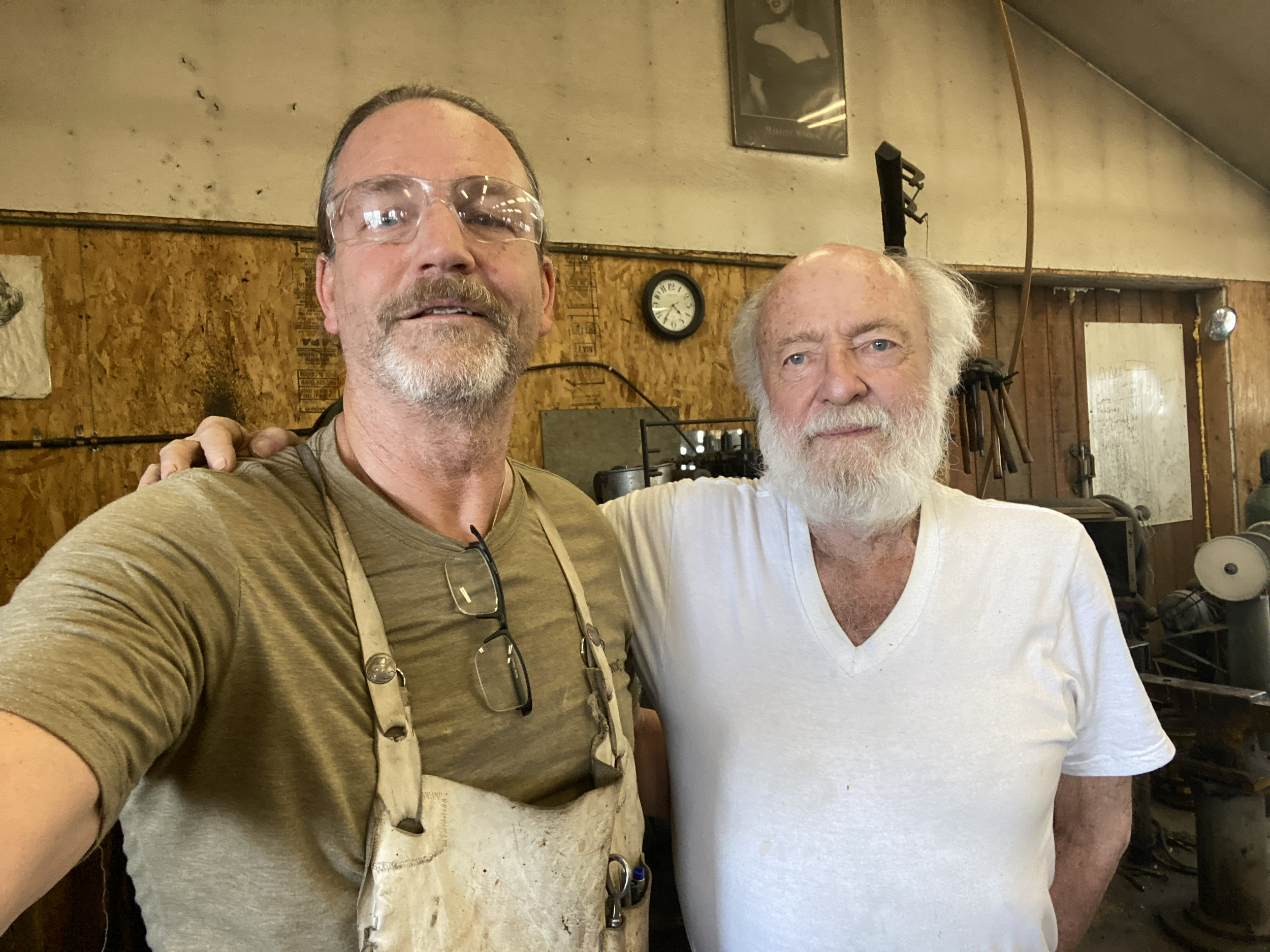
Beyond the steel and the science, Ed was deeply human.
He cared about people. About the craft. About doing things with integrity.
There was no pretense with him. No need to impress. What you saw was what you got—and what you got was authenticity.
In a world that often rewards noise over substance, Ed was steady, grounded, and real.
Carrying It Forward
Losing Ed is a loss to the entire bladesmithing community. There’s no way around that.
But what he gave us will live on in the disciples he shared his knowledge with.
And for me personally, it lives on in how I approach my work every single day.
Thank You, Ed
Thank you for the lessons.
For the honesty.
For the push to be better.
Thank you for setting a standard—and for showing us that it’s worth holding.
You’ll be missed more than words can say. But you won’t be forgotten.
—Larry